DV photo requirements
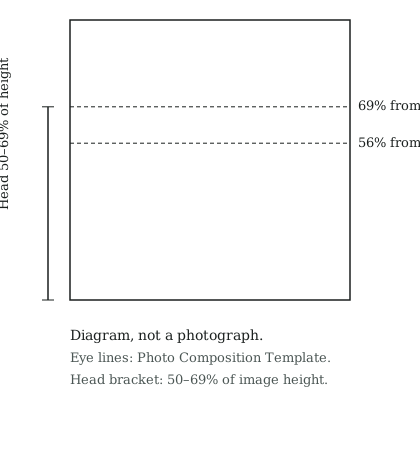
A DV entry photo is a color JPEG, 600×600 pixels, at or under 240 kB, on a plain white or off-white background, taken in the last 6 months, with no glasses. The head is 50–69% of the image height. Eye height should be 56–69% from the bottom.
Source: U.S. Department of State — last checked Oct 24, 2026.
DV-2027 entry instructions are not published. The rules below are from the current visa photo pages and the DV-2026 instructions, both checked on the date above. If the DV-2027 instructions differ, those instructions control.
Numbers used for a DV entry file
| Item | DV entry |
|---|---|
| File | Color JPEG (.jpg) |
| Pixels | 600×600 |
| Size | ≤ 240 kB |
| Background | White or off-white |
| Head | 50–69% of image height |
| Eyes | 56–69% from the bottom |
| Taken | Within the last 6 months |
| Glasses | Not worn |
The rule, then the sentence it comes from
File type
JPEG (.jpg), for the file uploaded with the entry.
In JPEG (.jpg) file format
The same line is in the DV-2026 instructions.
Pixel size
Exactly 600×600 pixels for a DV entry upload.
600x600 pixels in dimension
Image pixel dimensions must be in a square aspect ratio (meaning the height must be equal to the width). Minimum acceptable dimensions are 600 pixels (width) x 600 pixels (height). Maximum acceptable dimensions are 1200 pixels (width) x 1200 pixels (height).
The 600–1200 range is the general digital-image rule on the composition template. The DV entry rule on the photo page, and in the DV-2026 instructions, is 600×600. This site outputs 600×600.
Shape
Square. Height equals width.
In a square aspect ratio (height must equal width)
File size
At or under the published 240 kB limit.
Equal to or less than 240 kB (kilobytes) in file size
The State Department text says 240 kB and does not say whether a kilobyte is 1,000 or 1,024 bytes. This site rejects a file over 240,000 bytes.
Color
Color. Not black and white.
In color
In color
Focus
In focus.
In focus
DV-2026 plain-language instructions
“In focus” is in the DV-2026 instructions. On this site, a soft photo is a warning, not a blocked download. See How we check.
Head height
From the top of the head, including hair, to the bottom of the chin: 50–69% of the image height.
The top of the head, including the hair, to the bottom of the chin must be between 50% and 69% of the image's total height.
Sized such that the head is between 1 inch and 1 3/8 inches (22 mm and 35 mm) or 50% and 69% of the image's total height from the bottom of the chin to the top of the head.
Eye height
Eyes at 56–69% of the image height, measured from the bottom of the image.
The eye height (measured from the bottom of the image to the level of the eyes) should be between 56% and 69% of the image's height.
The template says the head “must” fall in range and the eyes “should.” The DV instructions point readers to that template for size details.
Background
Plain white or off-white.
Taken in front of a plain white or off-white background
Pose and expression
Full face, looking at the camera, neutral expression, both eyes open.
Taken in full-face view directly facing the camera
With a neutral facial expression and both eyes open
When it was taken
Within the last 6 months, and it must show how you look now.
Taken within the last 6 months to reflect your current appearance
If your photo(s) or digital image does not reflect your current appearance, even if it is not older than 6 months, the U.S. embassy or consulate will request that you provide a new photo with your application.
A file does not record the day it was taken. This site cannot check the six-month rule.
Glasses
Do not wear eyeglasses in a DV entry photo. The general visa photo page describes a rare medical exception. The DV-2026 instructions do not.
Do not wear eyeglasses.
DV-2026 plain-language instructions
Eyeglasses are no longer allowed in new visa photos, except in rare circumstances when eyeglasses cannot be removed for medical reasons; e.g., the applicant has recently had ocular surgery and the eyeglasses are necessary to protect the applicant's eyes. A medical statement signed by a medical professional/health practitioner must be provided in these cases.
If glasses are accepted for a medical reason, the photo page also says the frames must not cover the eyes, and there must be no glare, shadow, or refraction that obscures the eyes. This checker cannot apply that exception.
Head covering
No hat or covering that hides the hair or hairline, unless it is worn every day for religion, the full face is visible, and it casts no shadow on the face.
Do not wear a hat or head covering that obscures the hair or hairline, unless worn daily for a religious purpose. Your full face must be visible, and the head covering must not cast any shadows on your face.
Headphones
Not accepted.
Headphones, wireless hands-free devices, or similar items are not acceptable in your photo.
Hearing device
A hearing device that is normally worn may stay in the photo.
If you normally wear a hearing device or similar articles, they may be worn in your photo.
Clothing
Clothes worn on a normal day. No uniform, except religious clothing worn daily.
Taken in clothing that you normally wear on a daily basis
Uniforms should not be worn in your photo, except religious clothing that is worn daily.
Edits
Do not digitally change how you look.
Photos must not be digitally enhanced or altered to change your appearance in any way.
This site crops, resizes, and replaces the background. It does not change facial features. It also cannot tell whether a filter was applied before upload.
What is not a photo for this purpose
Do not upload a scan of an ID, a snapshot, a magazine photo, a low-quality machine or phone photo, or a full-length photo.
Photos copied or digitally scanned from driver's licenses or other official documents are not acceptable. In addition, snapshots, magazine photos, low quality vending machine or mobile phone photos, and full-length photographs are not acceptable.
Scanning a print
If the digital file is a scan of an existing photo, that print must also be 2×2 inches (51×51 mm) and scanned at 300 pixels per inch. The JPEG rules above still apply.
2 x 2 inches (51 x 51 mm)
Scanned at a resolution of 300 pixels per inch (12 pixels per millimeter)
The photo page lists those two lines under “Do you want to scan an existing photo?” in addition to the digital image requirements.
Photo-related disqualification, in the DV-2026 instructions
DV-2027 instructions are not published. These two sentences are from the DV-2026 plain-language instructions. They are not restated here as a DV-2027 rule.
You may be ineligible for a DV if the entry photographs for you and your family members do not fully meet these specifications or have been manipulated in any way. Submitting the same photograph that was submitted with a prior year's entry will make you ineligible for a DV.
Submitting the same photograph that you submitted with a prior year's entry, a photograph that has been manipulated, or a photograph that does not meet the specifications below may make you ineligible for a DV.
DV-2026 plain-language instructions
Who decides
The sentences below describe the Department of State’s own photo crop tool, not this website.
This tool is intended for photo cropping only. A Department of State employee will make the final decision whether your visa photo is acceptable or not for your application.
Acceptable and unacceptable photographs
The Photo Examples page shows photographs the Department marks acceptable or unacceptable, including size, expression, head position, background, and anything that obscures the face. Those photographs are not copied here.
Photographing a baby
From the photo requirements page:
When taking a photo of your baby or toddler, no other person should be in the photo, and your child should be looking at the camera with his or her eyes open.
Lay your baby on his or her back on a plain white or off-white sheet. This will ensure your baby's head is supported and provide a plain background for the photo. Make certain there are no shadows on your baby's face, especially if you take a picture from above with the baby lying down.
Cover a car seat with a plain white or off-white sheet and take a picture of your child in the car seat.
If selected: two prints at the interview
Entry uses the digital file. The photo page says each DV applicant brings two identical photos to the interview:
Printed on photo quality paper
2 x 2 inches (51 x 51 mm) in size